


HELLSTONE CAPTURE | SECOND ENTITY.
And then, she felt it, felt that beautiful, twisted darkness … and she crawled toward it.
Let’s jump into the deep end and what it took to build a homemade recording studio, the costs, what I’ve learned, and most importantly, who almost did Maro’s Red Creek audiobook. The brimstones are calling for ‘no mercy, just blood.’ And I’m going to give it to you.
I know you’re curious who almost did Red Creek, so we’ll start there. Steven Pacey: the incredible narrator behind renowned books like Joe Abercrombie’s First Law Trilogy. The man’s a legend with his voice work, and as far as I’m concerned, he could narrate all the books in the world, and I’d never grow tired of it.!
When I considered doing an audiobook for Maro, he was the first person—and quite frankly, the only person—I considered. Maybe, for a span of seconds, I considered Michael Kramer, one-half of the power duo of Kate Reading and Michael Kramer—you know, the duo that did the Wheel of Time and a lot of Brandon Sanderson books?
Once, in a land far, far away—Hawaii—I almost booked Mr. Kramer to do The Dark Portal, and at the time, it wasn’t financially feasible. Hawaii’s the most expensive place I’ve ever lived, and I worked three weeks out of the month for my rent, and living off a week’s worth of wages for bills, food, and everything else.
Fast forward to Red Creek, looking up Steven Pacey and the studio, I thought surely this time, it’d be a dream coming true! Alas, like Mr. Kramer, the price was out of reach. And when I tell you how much, you’ll understand why I had to build the damn thing myself!
It wasn’t cheap, but context is needed. When I spoke with Mr. Kramer, it was roughly $1500 for three hours of work. It actually wasn’t a bad price, especially considering he records at home. I was close to pulling the trigger and risking debt. Mind you, this was 2021, right after Rhythm of War came out. So, not that long ago, but four years is a difference of a lifetime.
Mr. Pacey … it was a flat $2,500–$3,000 just for him to narrate it—depending on time in studio. That didn’t include cost of studio time/studio rental space, nor editing it. Three grand for the rough cut. After inquiring futher, it came out to about $6,000.
A dream just died—millions of voices crying out in terror and were suddenly silenced.
And now, you know why I had to build it myself. Now, you know why I spent my hard-earned money to craft something that’d last. I couldn’t half-ass it, and I don’t do things by half-measures when it comes to my books.
How it started:
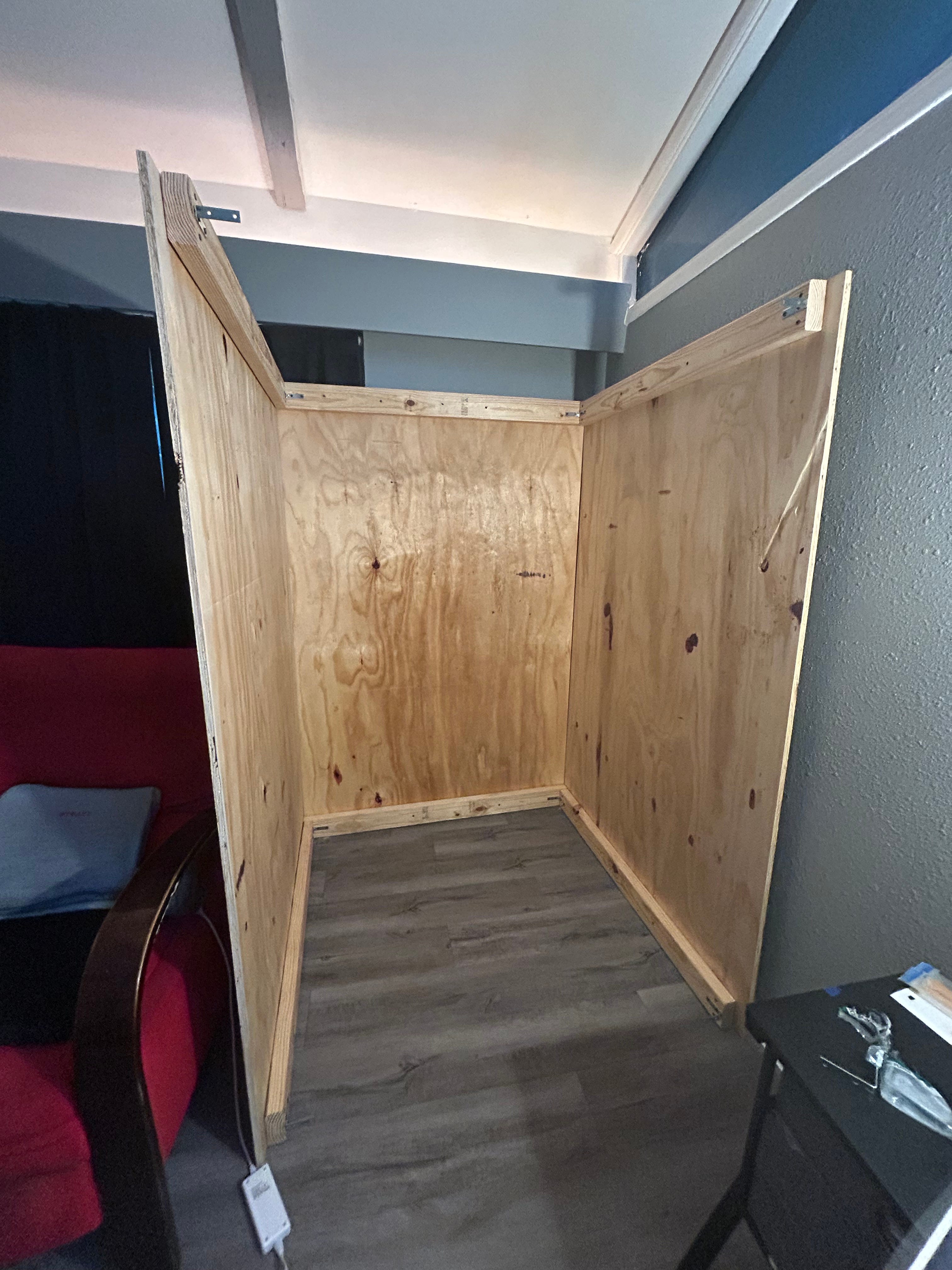
Let’s break down exactly how this went down.
Hardware:
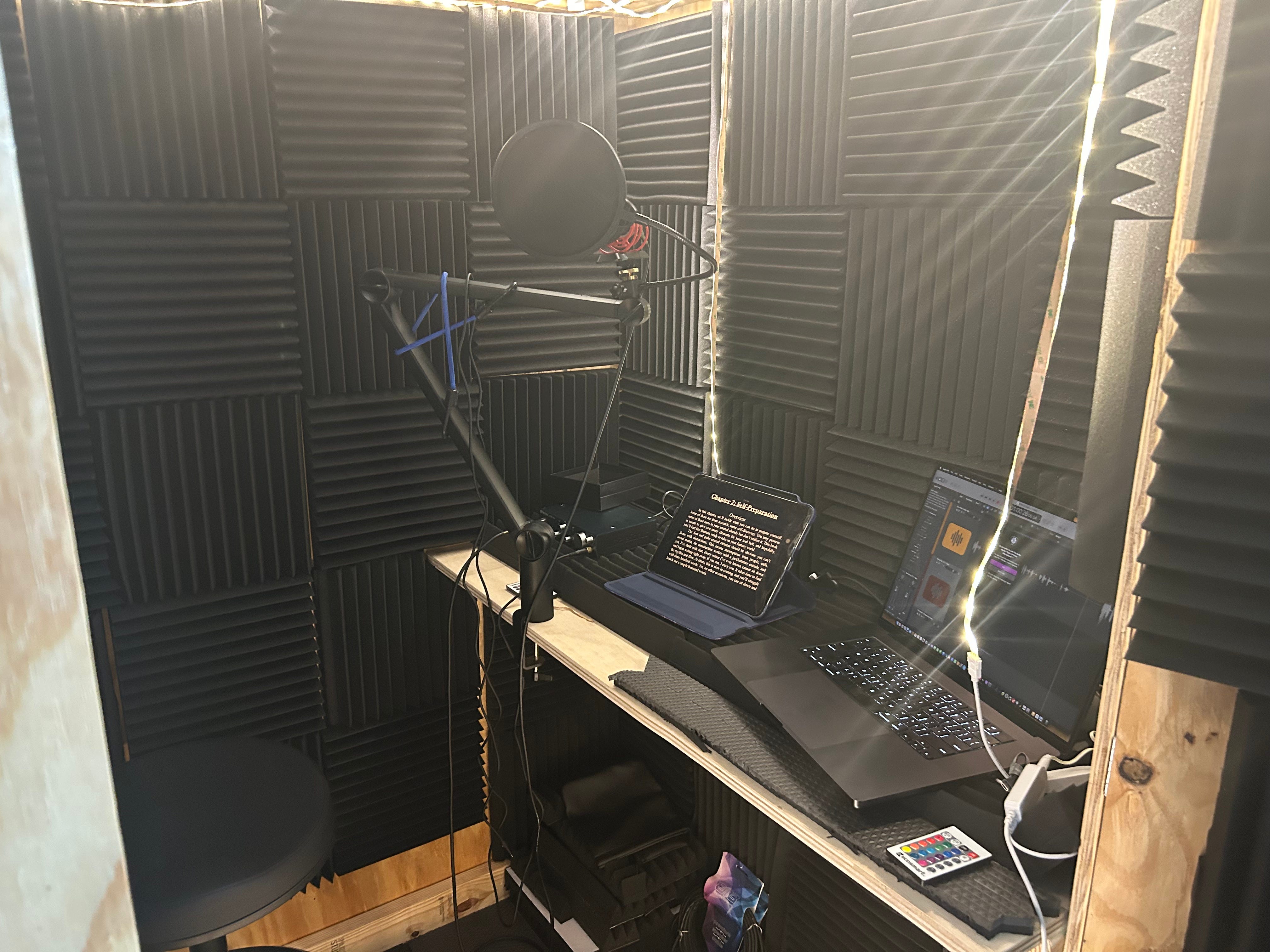
It started with plywood, four sheets of 4x8. I cut off the top two feet since I’m not going to grow any taller. No need to waste space or foam.
So, now we’ve got four 4x6s.
For the record, I built this thing to come apart with ease. That was rule #1 when going in. If I have to move, this should come apart and be put back together just the same. The walls are held together by L-brackets at the top and bottom, and the wood slightly bulges at the middle. This isn’t a beauty contest, so aesthetics aren’t a factor, just function.
With the lopped off two feet from the plywood, I enclosed the top. On one side, I put some 2x4s along the back wall and a little on the sides, and this formed the support for my fold-down desktop—wood on hinges so in teardown mode it doesn’t have to be removed.
Recap: walls, ceiling, and desktop.
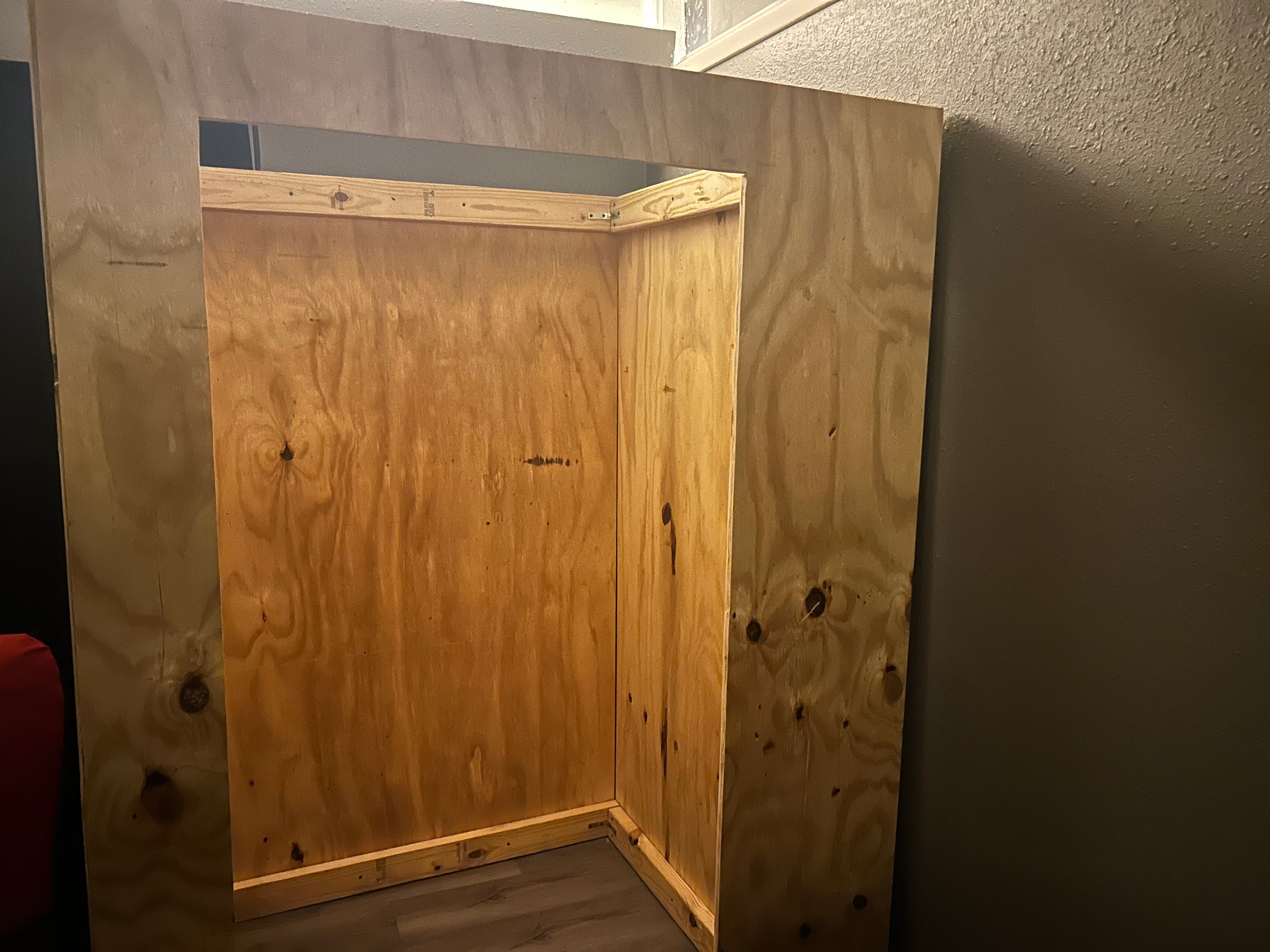
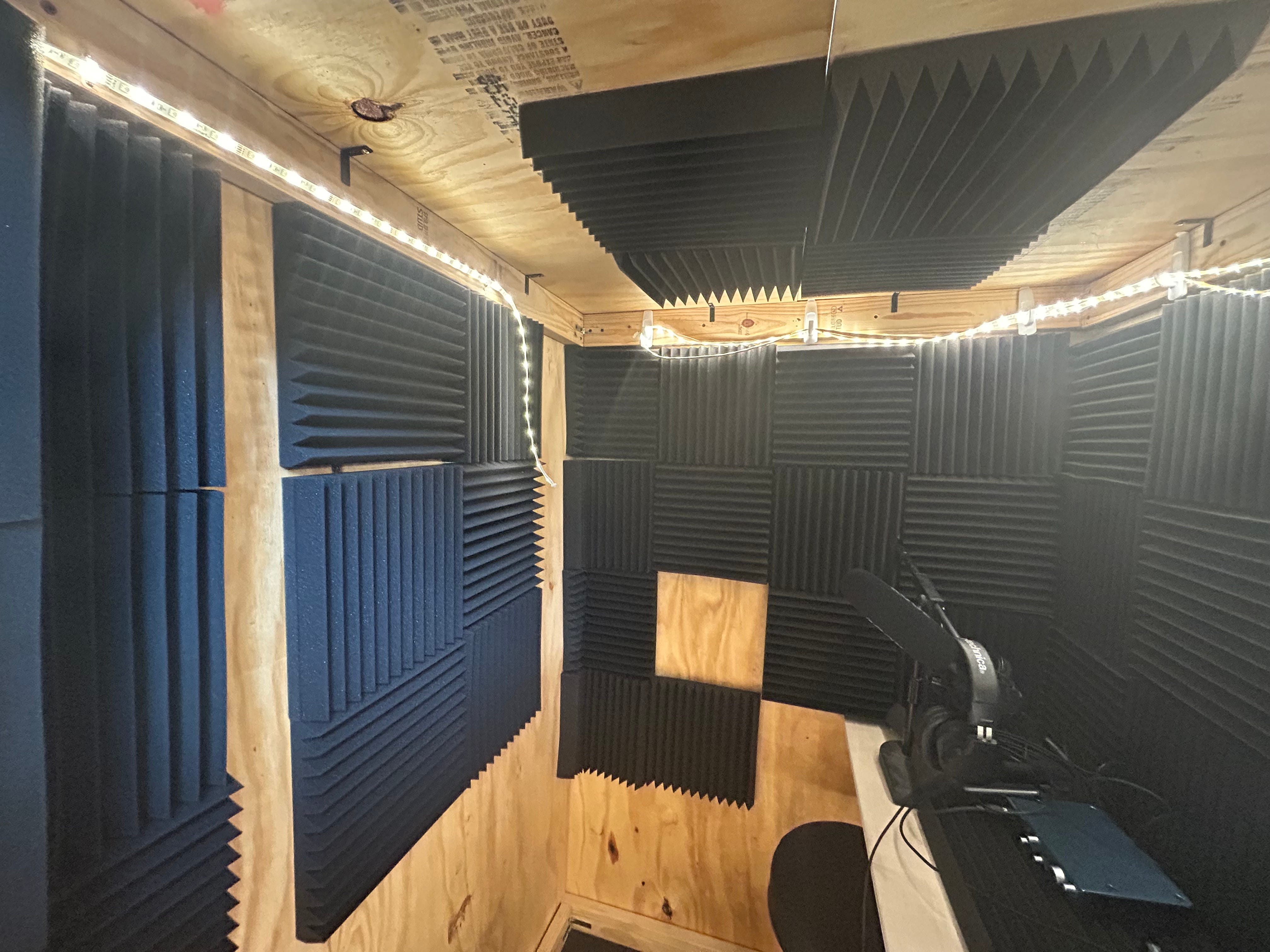
Next, the floor. I bought foam padding, the kind you’d buy for a homemade gym. Soft, durable, but stiff enough that I’m not going to sink in it. Jumping ahead just a touch, I placed a blanket over it because the microphone picks up each little movement or shift like crazy!
Then came the foam/ sound panels: 2x2x12, alternating on the walls and how they hang. Covered most of the wall and a good portion of the ceiling. The air might turn dead when you step into the booth, but the story will come to life.
Let’s talk cost so far. I’m revealing this in case you ever want to build yourself something similar, you’ll have an idea of what it’ll cost.
The wood, well over $100. I don’t have it written down in my business expenses, so I will be rectifying it shortly. If I recall, it was around $34 a sheet. Or I could be dyslexic, and that was $43 a sheet. Either way, a chunk.
For the desk wood, I bought something nice, already sanded and treated, and though small, it ran me about $60. I didn’t want to get splinters and crap while recording.
I don’t have the cost for the L-brackets or hinges, but it was fairly small considering the overall price.
Foam panels: I bought 98 of them: a pack of 50 for $51.08, and two packs of 24 for $35.99. The price difference is because the first pack wasn’t self adhesive, but the other two were. So, I’ve got a mishmash of both inside.
The foam on the floor? Can’t remember—a Costco buy, and it came with 4 big ones, but it was under $50. I’m always hunting for a deal, so when I saw it, I was like, “Yup, I’m getting that!”
Total cost?
Wood: $150.
Desk: $60.
Mats: $50
Foam: $123
Total: $383.
Let’s call it $400 for ease of tracking.
Electronics:
Okay, that covers the nontechnical aspects. Let’s turn to the guts of the booth.
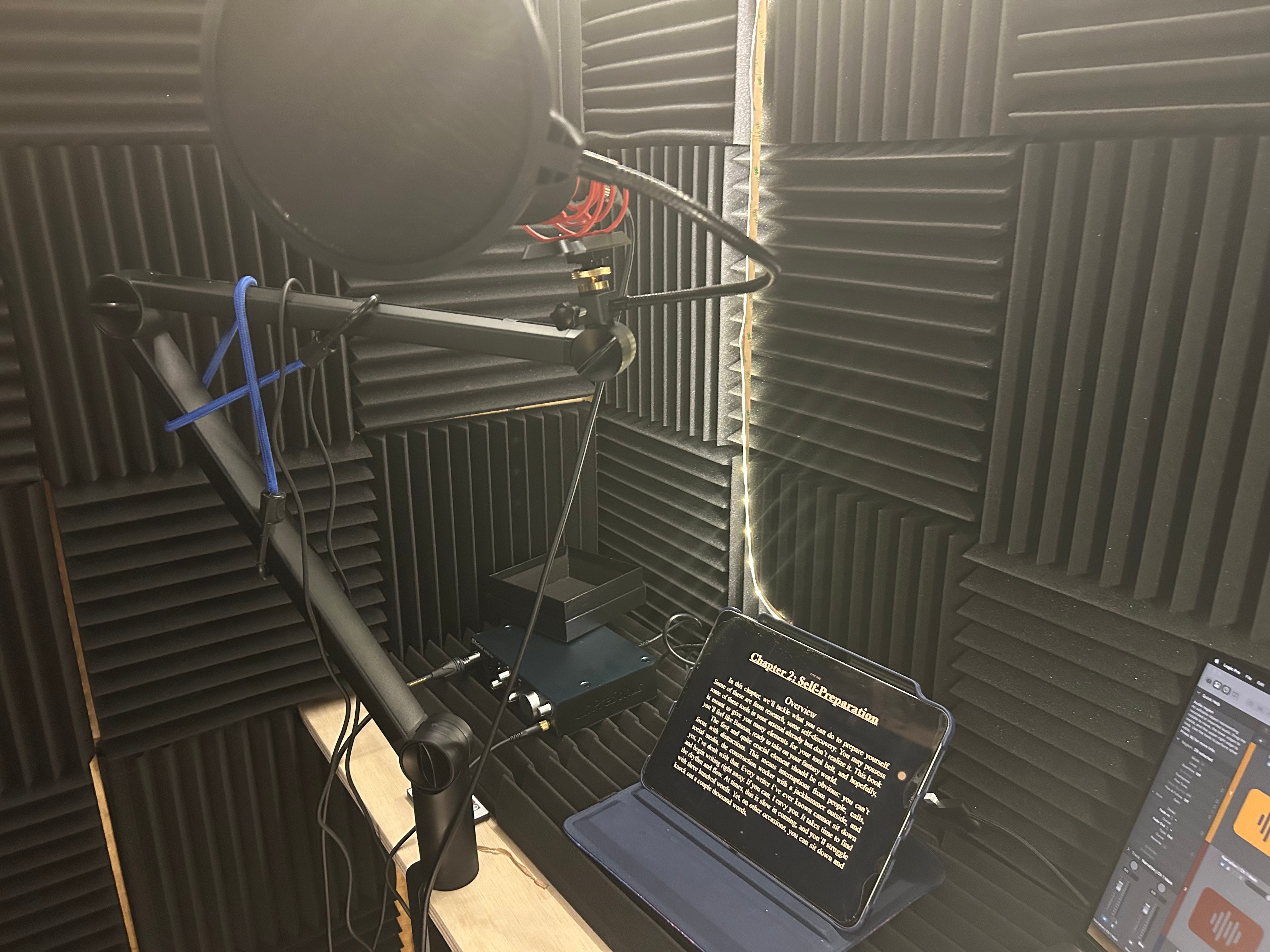
I needed: a microphone, pop filter, stand/boom arm, an audio interface, cables for the mic, decent headphones, and software to record on.
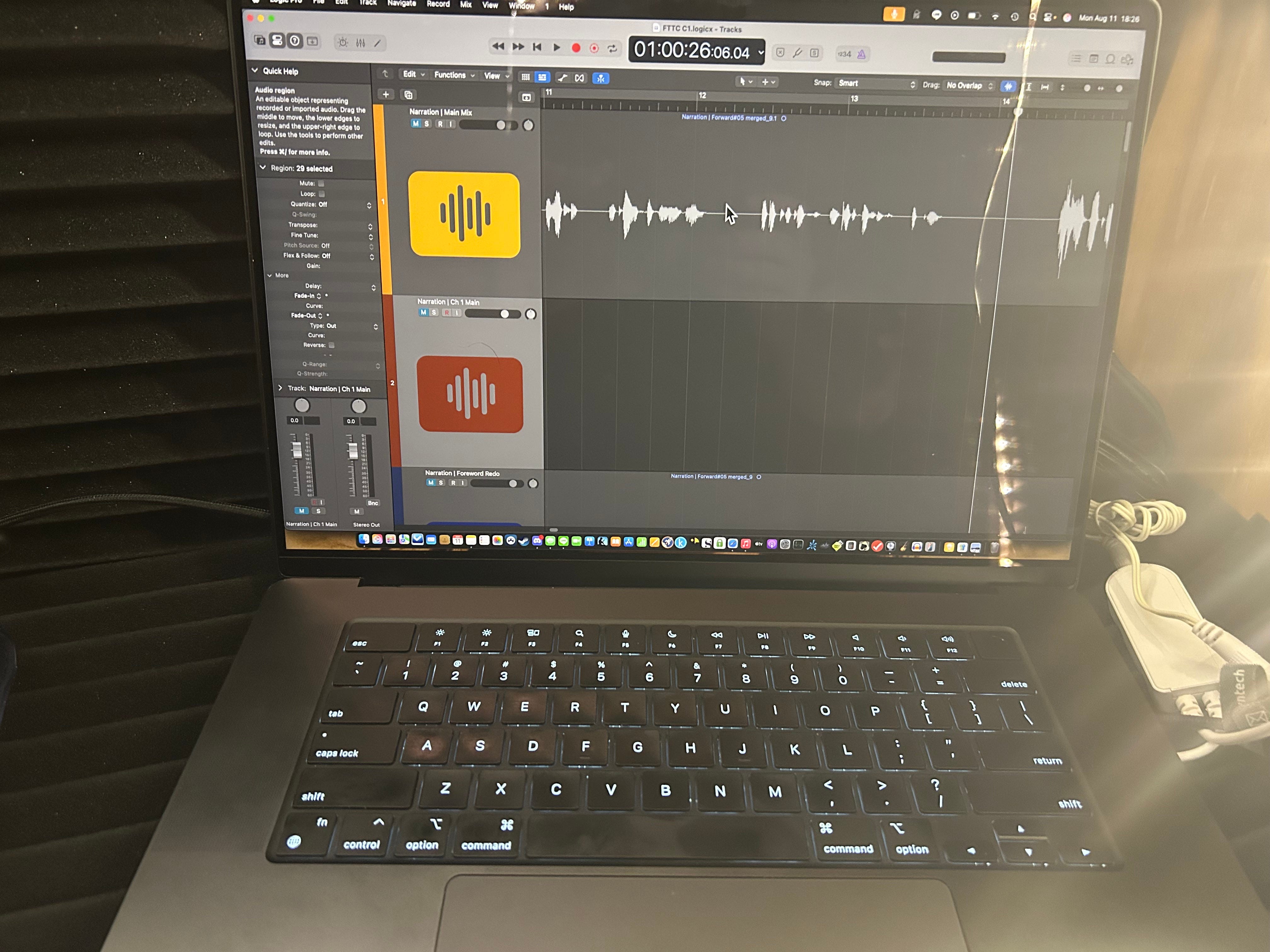
For the software, I almost went with Audacity, and though free—which I’m always hunting for a deal—it came across as clunky and crude. I did some searching to see what meshed well with a MacBook, consulted AI, and settled for Apple’s Logic Pro—formerly known as Logic Pro X.
That cost me a solid $199 before taxes. Still, that’s not bad at all, but let me tell you, the learning curve is steep—and I’ve been recording music for years. I’m either looking up YouTube videos or hounding AI with questions on how-to.
For the mic, which is essential and pivotal, I did some research, and the details that came back about Rode NTG4 Shotgun microphone was what I wanted to hear. I snagged it for $318.26.
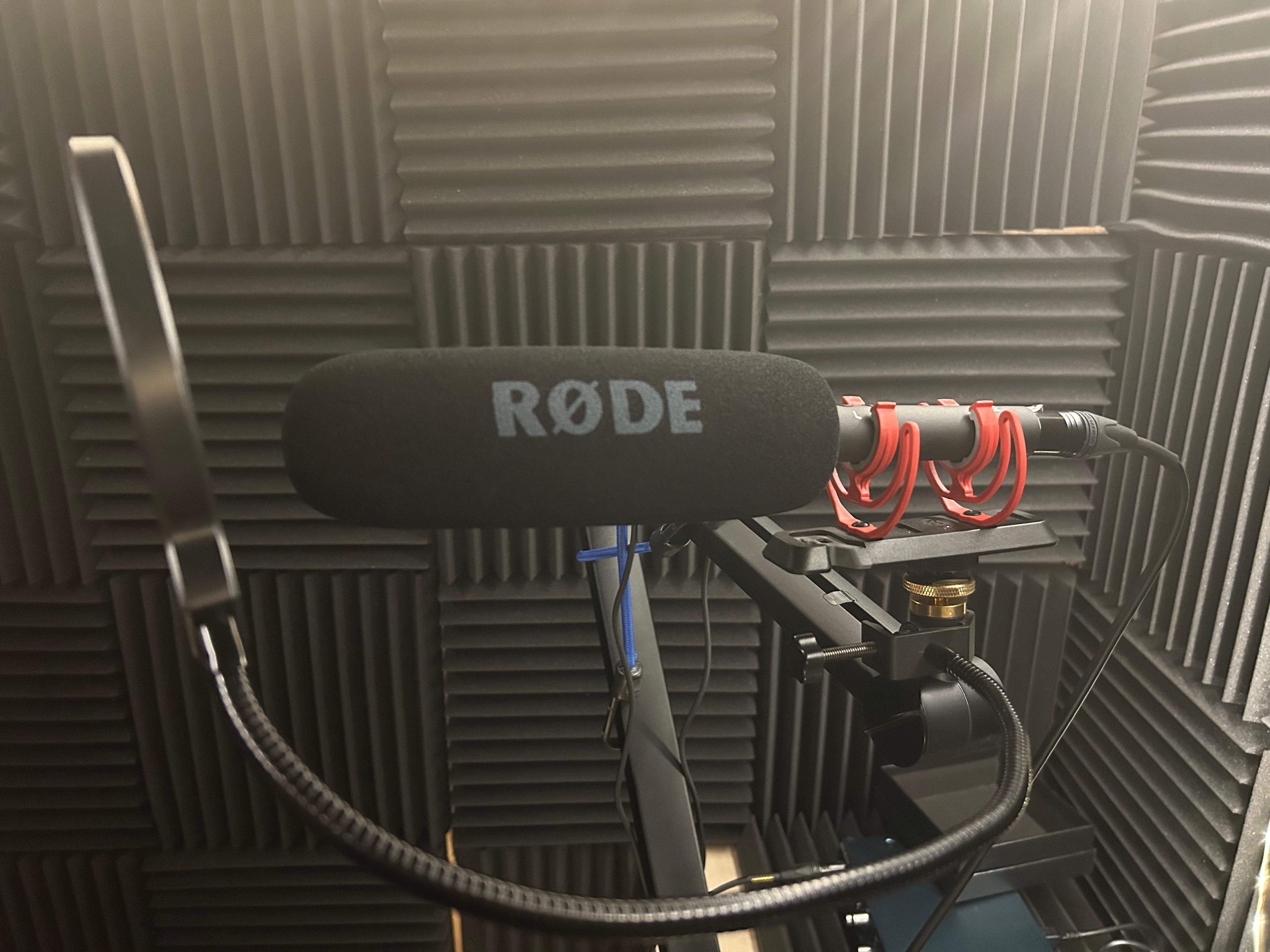
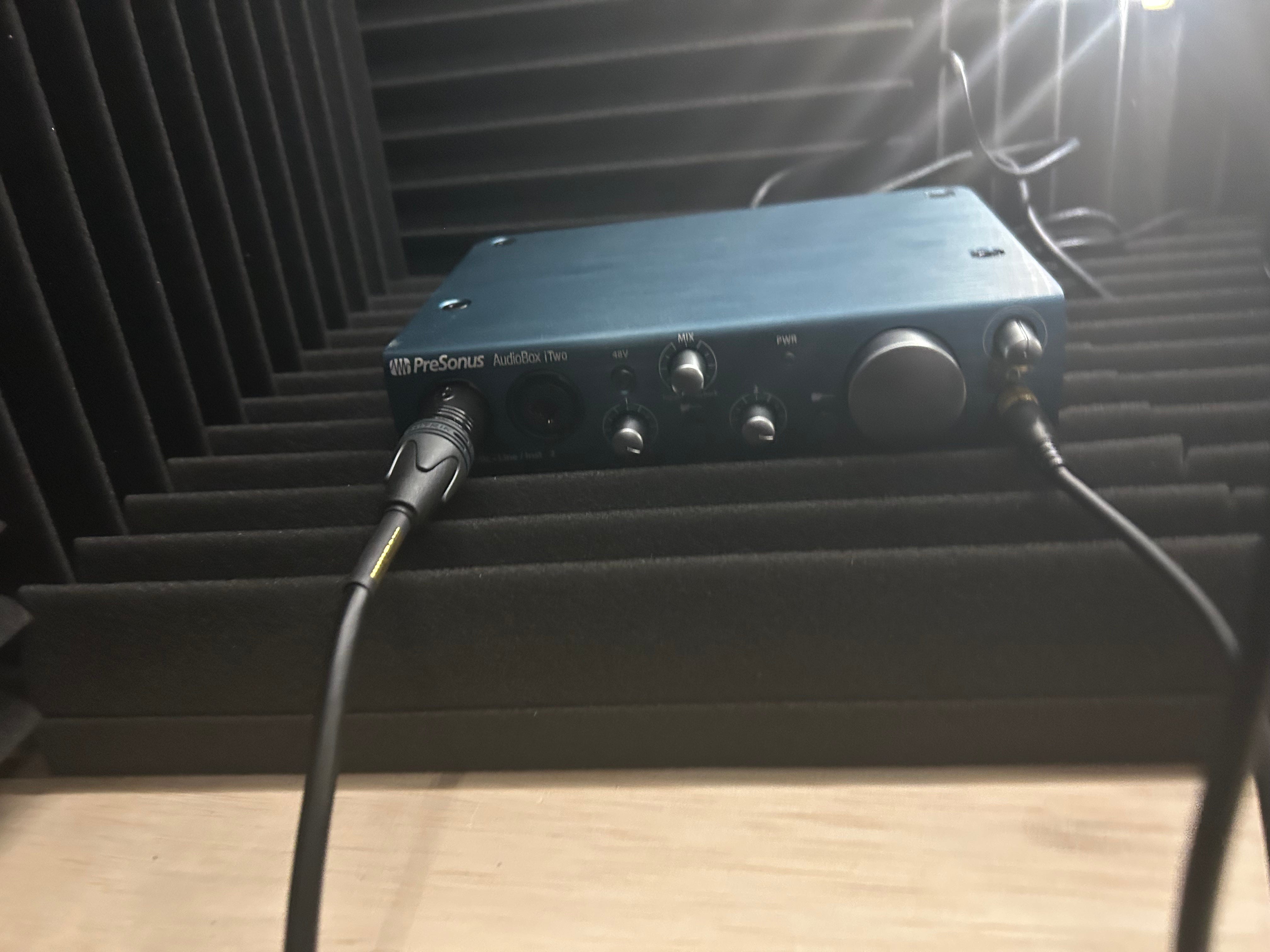
To go with the system and mic, you need a cable and audio interface and all the bells and whistles. The PreSonus AudioBox iTwo USB Audio Interface came out to $184, the cable—which I bought a quality one—Mogami Gold Studio 10 XLR Cable, came in at a whopping $73.56. And, let’s not forget the Blue Microphones Compass Premium Microphone Boom Arm at $89, or the pop filter at $13.
Rounding out the essential list, quality headphones so I can hear what the hell’s going on. Audio-Technica ATH-M50x Professional Studio Headphones swooped in to save the day for the low, apoplectic cost of $159.
But the sound quality’s worth it! I especially like how the plug into the headphones is a partial screw in. Should I catch something on the cord, it’s not going to yank out and leave me stranded.
Recap:
Logic Pro: $199
Mic: $318
Wood: $400
Total: $917.
Let’s keep it simple at $900.00.
PreSonus: $184
Cable: 74
Boom arm: $89
Pop Filter: $13
Headphones: $159
Grand Total: $1,419.
Plans:
Overall, I built my own studio for the same price as paying Mr. Kramer in 2021 for one novella. But the good thing? I have all the equipment, and I can record my own books without a huge studio, a time crunch, or a high dollar-demanding talent—even if I still dream for Mr. Steven Pacey and his quality grit.
Right now, I’ve got three books I want to record, Maro 1 & 2, and Flawed to the Core. The plan is to record all of Maro books, and I might even throw in The Dark Portal, too.
My hope is to capture another audience, the audiobook spectrum. As a former reader myself, and an Audiobook enthusiast, I know there’s a market for it.
Recording:
Which brings me to the last portion. Someone once said to me—actually, a lot of people said it to me—I’m my own worst critic, and they’re right. I demand much, but I expect much, myself foremost on the list. So, with these early attempts at recording, I haven’t been satisfied. I know eventually I’ll get there, but one thing I’ve learned very quickly is: fix it in post!
As long as there’s a clean take, I can literally read a sentence over the span of thirty seconds, taking longer pauses in between commas, making sure I get it right, and no one will be the wiser once the editing is done.
Crazy, right?
I’m not concerned with doing the voices of characters—I’ve been doing that since childhood—and sometime during my teen years, I realized people looked at me like I was weird for doing it, so I stopped … in public.
The voices will come easy, it’s just a matter of selecting the right one for the right character. After that, it’s going to be so much fun!
That said, it’s my narrating voice that gives me the most worry, and this is where I’ll have the hardest time of not demanding absolute perfection. Yes, great work—splendid work—but perfection? It’s a myth we chase, and I just got to come to terms with it.
Expect rough cuts to drop soon…
Well, the booming voice from the town herald has shouted out the news. Now, citizens return to their lives. That’s all I got for this round—short, sharp, and sweet. I shall return…